.webp)
Why Falling Is the Point: How Fall Guys Turns Failure into Comedy, Tension, and Competition
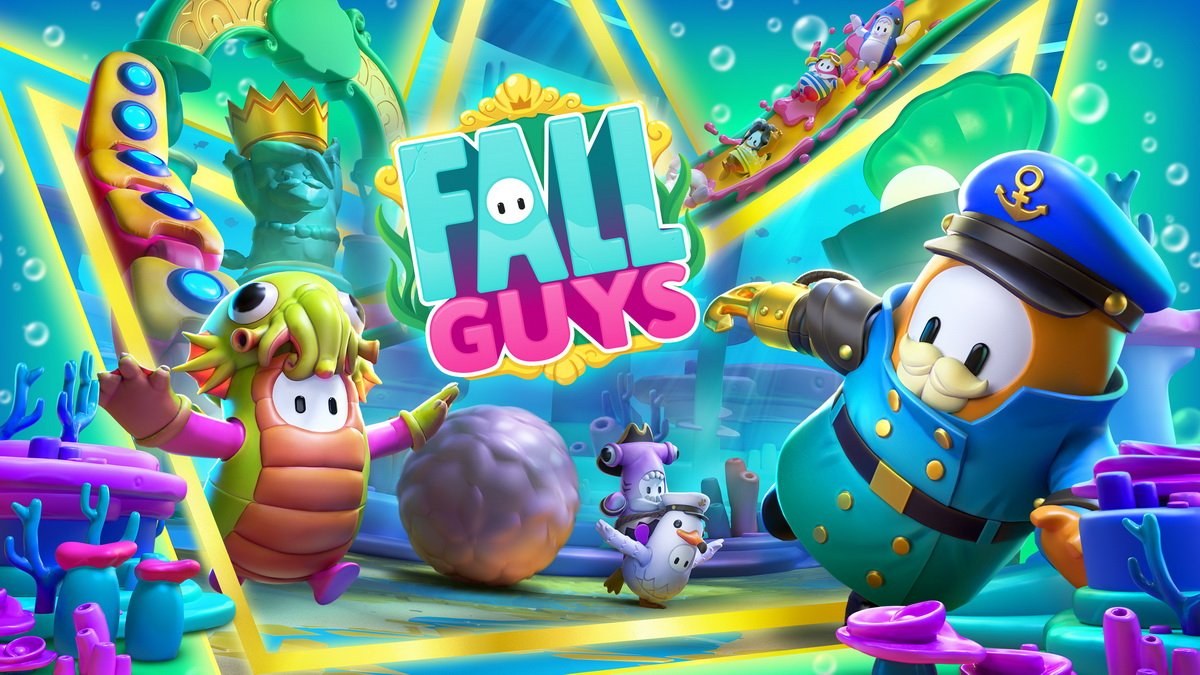
A contestant approaches the finish line with enough space to qualify. One rotating obstacle remains. The jump looks routine, the timing seems comfortable, and the player commits. Then another bean lands awkwardly nearby, the two bodies collide, and a manageable leap becomes an uncontrolled tumble. Seconds later, the qualification counter fills. From the player’s perspective, the sequence is a small disaster. From a spectator’s perspective, it is an almost perfectly structured joke: confidence, interruption, escalation, and an ending delivered at the worst possible moment.
This relationship between personal disappointment and public entertainment is central to Fall Guys. Its distinctive achievement is making failure serve several purposes at once. A fall can teach a mechanical lesson, interrupt a predictable race, create an unexpected rivalry, or supply the most memorable moment of an entire session. The following analysis traces that relationship from the game’s launch through its competitive structure, growing player expertise, and introduction of Creative. The central argument is interpretive: Fall Guys works because it makes losing expressive, while continually testing how much unpredictability players will accept when victory matters.
1. The Launch Premise: A Competition Built Around Visible Imperfection
A Different Kind of Elimination Spectacle
When Fall Guys arrived in August 2020, its original presentation placed up to 60 contestants inside a succession of colorful challenges, with elimination gradually reducing the field. PlayStation’s launch announcement described both competitive free-for-alls and cooperative challenges, establishing a format in which contestants could alternate between individual ambition and temporary collective responsibility. That structure matters because it surrounds a simple ambition—survive and eventually win—with constantly changing reasons for failure. A contestant might misjudge an obstacle, become trapped in traffic, or depend on teammates whose decisions remain outside their control. The competition therefore begins with an unstable relationship between effort and outcome. Players can influence events without possessing complete authority over them.
The Contestant Is Already Part of the Joke
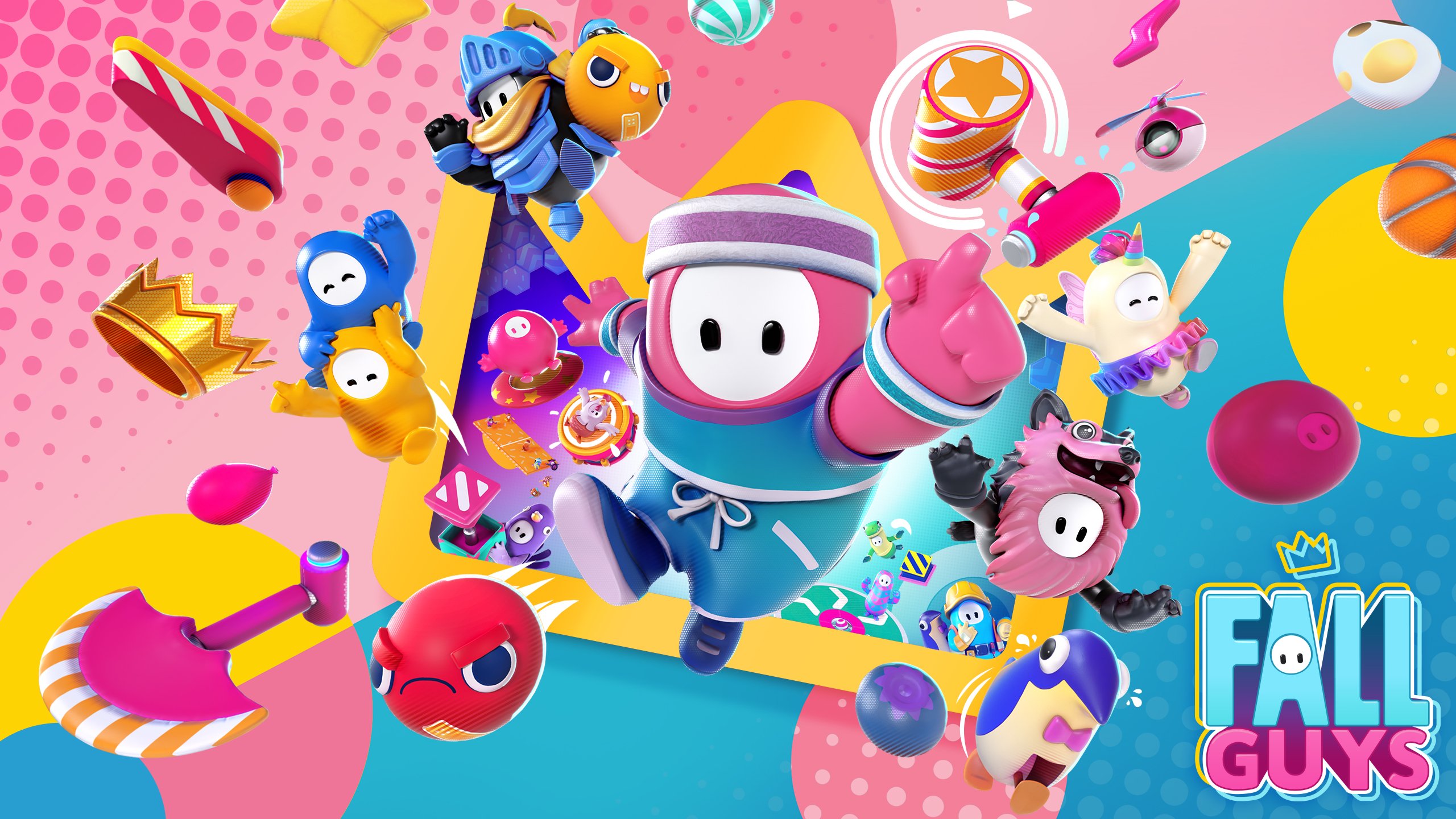
The bean-shaped character makes that uncertainty immediately visible. Its rounded silhouette, small limbs, and exaggerated movement communicate determination without conveying physical elegance. A contestant can appear completely committed to an action while remaining comically unsuited to performing it gracefully. This creates an important emotional buffer. A fall still interrupts progress, but the character’s appearance frames that interruption as slapstick before the player has time to interpret it as humiliation. The costume deepens the effect: a brightly dressed figure flailing across an inflatable obstacle invites a different response from a realistic athlete suffering a technical mistake. The game’s visual language makes incompetence feel compatible with participation.
Why Imperfection Sustains the Premise
That compatibility distinguishes Fall Guys from competitions whose presentation assumes mastery. Here, awkwardness belongs to the fantasy. The player enters a world in which everybody looks vulnerable, including the eventual winner. This does not eliminate skill differences, but it prevents the surface of the game from becoming entirely solemn. An expert can still be launched into the air, stumble during a crowded landing, or miss a decisive opportunity. The resulting spectacle preserves a shared condition: every contestant inhabits a body capable of embarrassing them. From the beginning, failure is therefore more than a penalty imposed on unsuccessful players. It is the common physical language through which the competition becomes recognizable.
2. The First Obstacle: How Movement Creates Comic Timing
Intention Meets Interruption
The basic comic unit in Fall Guys is the gap between what a player intends and what the character visibly does. Moving toward a platform expresses a clear plan. Jumping commits the body to that plan. Contact with an obstacle or another contestant can then redirect the movement, producing an outcome that looks dramatically different from the original intention. This sequence resembles physical comedy because the audience can understand both sides immediately. The intended action is legible, and so is the interruption. No lengthy explanation is needed to recognize why a confident approach followed by a sideways tumble is funny. The body supplies the narrative.
Recovery Extends the Scene
A fall becomes more expressive when it does not immediately end the attempt. A contestant may land awkwardly, regain footing, slide toward an edge, and recover again. Each transition briefly changes the apparent outcome. What seemed disastrous becomes survivable; what looked safe becomes dangerous. These reversals give movement a rhythm beyond the simple division between success and failure. They also make spectators watch through the entire incident. The entertaining question is no longer just whether the jump succeeded. It becomes whether the bean can escape the consequences of a mistake that continues unfolding. The recovery is part of the performance, sometimes more memorable than the initial collision.
The Boundary Between Comedy and Distrust
However, this effect depends on the player believing that the interruption belongs to the game’s physical world. An understandable collision can be funny even when it is costly. An outcome that appears disconnected from the visible action is more likely to feel arbitrary. The distinction is interpretive rather than absolute: two players may read the same incident differently, especially under pressure. Nevertheless, the design problem is clear. Fall Guys benefits from unstable bodies, but it also needs sufficiently understandable relationships between movement, contact, and consequence. Comic unpredictability becomes frustrating when the player cannot construct a plausible account of what happened. The joke needs a cause, even when that cause is an absurd pile of contestants.
3. The Opening Crowd: When Other Players Become Moving Obstacles
Traffic Transforms Familiar Terrain
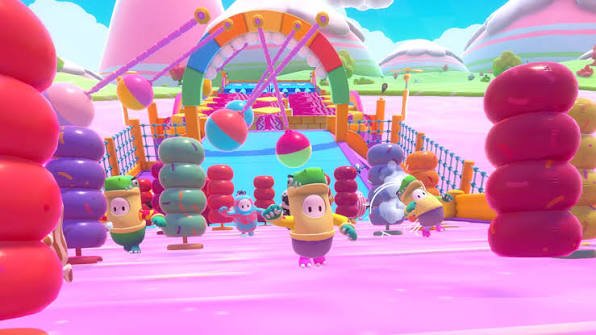
In an empty obstacle course, the relationship between the player and the environment is relatively direct. A rotating bar follows its pattern, a platform occupies its position, and a gap demands a particular movement. Add a crowd, and those same features acquire another layer of uncertainty. A landing area can disappear beneath several bodies. An unobstructed approach can become congested. A contestant recovering from a fall can interrupt someone who had executed the preceding section cleanly. The course now contains two interacting systems: its designed machinery and the temporary arrangement of players moving through it. Failure emerges from their intersection rather than from either system alone.
Individual Decisions Produce Collective Disorder
The interesting feature of this disorder is that it need not come from irrational play. Several contestants can independently identify the same attractive route, move toward it, and create congestion that makes the route less attractive for everyone. The resulting collision is a collective consequence of individually reasonable choices. This gives Fall Guys a social dimension even without conversation. Bodies communicate priorities through movement: urgency, hesitation, imitation, or refusal to yield. A crowded obstacle becomes a brief negotiation conducted through position. Each contestant wants progress, but the shared space cannot always accommodate every preferred action simultaneously. Comedy arises when that conflict produces a result nobody specifically intended.
The Crowd as an Accidental Author
Other players therefore help author the obstacles encountered during a round. They do not need editing tools to change how a section feels. Their presence changes the available space, the timing of an approach, and the consequences of contact. This is one reason a familiar course can still generate new incidents. Its underlying geometry may remain recognizable while its human arrangement changes from attempt to attempt. The environment establishes possibilities; the crowd determines which possibilities become immediate problems. At its strongest, this relationship makes failure feel socially specific. The contestant remembers being caught behind a particular group or displaced during a particular scramble, rather than merely remembering that an obstacle was difficult.
4. The Qualification Line: How a Small Mistake Becomes a Dramatic Loss
Relative Success Changes the Meaning of a Fall
Qualification introduces a distinction between performing an action successfully and performing it soon enough. In a race with a limited number of qualifying places, finishing the course is not the only relevant achievement. The player must finish before the available positions disappear. Consequently, a mistake carries a relative cost. A tumble that would be insignificant during an isolated practice run may become decisive when several contestants are approaching the finish together. This converts movement errors into competitive events. The fall matters because of what other players accomplish while it happens. Its significance cannot be understood from the character’s position alone.
The Counter Creates a Parallel Countdown
The qualification counter intensifies this relationship by translating distant opponents into an immediate numerical threat. The player may not see every contestant crossing the line, yet the shrinking supply of places makes their progress visible in another form. This creates two simultaneous narratives: the physical effort to complete the course and the numerical disappearance of opportunity. Near the end, a small delay can connect them suddenly. A recovery that takes only a few seconds may coincide with the final available places being claimed. The emotional force comes from synchronization. The player sees both the obstacle that delayed them and the count that confirms the consequence.
Near Misses Make Failure Memorable
Close losses are especially powerful because they invite a counterfactual story. The player can imagine a version of events in which one collision did not happen or one landing went differently. This imagined alternative keeps defeat psychologically active after the round ends. A distant loss may be easy to dismiss; an almost-qualified finish seems to contain an unfinished possibility. That can encourage another attempt, although it can also intensify frustration. The same structure supports both responses. Fall Guys does not make every failure emotionally light. Instead, its cheerful presentation surrounds a system capable of producing sharp disappointment precisely because the difference between continuation and elimination can appear so small.
5. Rising Stakes: The Shift from Recoverable Mistakes to Elimination
Not Every Fall Has the Same Meaning
As a competition moves between different round structures, the consequences of failure can change. In some contexts, falling mainly costs time and position. In others, entering a hazard ends participation in that round. This difference transforms the emotional character of movement. A risky action with a recoverable consequence invites experimentation because the player expects another opportunity. A similar action above an elimination boundary feels more final. The visible movement may be equally absurd, but its competitive meaning has changed. The game can therefore reuse the expressive potential of an unstable body while varying how much emotional weight the resulting tumble carries.
Pressure Changes the Interpretation of Contact
Slime Climb illustrates how a race can acquire survival pressure through its rising hazard. The course is not simply a route toward a finish; it is a space becoming less forgiving over time. Under that condition, hesitation and obstruction become more threatening. A crowded section consumes a resource that cannot be recovered: the remaining margin before the hazard reaches the player. An accidental bump can consequently feel more consequential than the same contact in a forgiving early race. The comedy remains visible to an observer, but the participant may experience the incident primarily as loss of control. Stakes do not erase slapstick; they change whose perspective finds it amusing.
Escalation Gives the Competition an Emotional Shape
This variation prevents failure from becoming a single repeated sensation. A session can contain messy recoveries, nervous survival, and abrupt elimination, each producing a different kind of attention. The important progression is not that every successive round must mechanically become harder. It is that continued participation increases the amount of the current run a player has invested in. Even a familiar obstacle can feel different after several successful qualifications. The contestant is protecting accumulated progress as well as navigating the immediate environment. By this stage, falling has acquired a history: it threatens to end a sequence the player has already begun to treat as their particular story.
6. Shared Responsibility: Team Failure and the Search for Someone to Blame
The Individual Body Enters a Collective Result
Team-based rounds introduce a different relationship between action and consequence. A player can perform a useful local task and still lose because the team’s overall result is insufficient. Conversely, a player can make several mistakes while teammates preserve the group’s position. This weakens the direct connection between personal execution and qualification. The resulting uncertainty is social rather than purely physical. The contestant must interpret a shared outcome assembled from many partially visible actions. A single camera cannot reveal every contribution, so the player’s explanation of defeat is necessarily incomplete. What felt like an obvious cause from one position may have been only one part of a much larger failure.
Comedy Becomes Collective Confusion
Fall Ball makes this relationship particularly legible through the contrast between a recognizable sporting objective and the awkward bodies attempting to achieve it. A ball can draw several contestants toward the same space, creating crowded attempts at intervention whose outcomes are difficult to attribute cleanly. A useful touch, an unfortunate deflection, and an accidental obstruction may occur within moments of one another. The spectacle resembles organized sport breaking down into improvised physical comedy. Yet the score still supplies a clear judgment. The action may be confused, but the result is definite. That contrast makes the round entertaining while leaving considerable room for disagreement about responsibility.
Shared Defeat Can Unite or Divide
Among friends, this ambiguity can support playful storytelling. A conspicuous mistake becomes a recurring joke, and a collective collapse becomes a shared memory. With unfamiliar teammates, the same ambiguity can encourage blame because the player lacks the social context that would make the incident affectionate. Team failure therefore reveals a limit of the game’s cheerful presentation. Visual comedy does not automatically create social generosity. The outcome depends partly on whether players experience one another as companions in a ridiculous situation or as obstacles to an individual objective. Fall Guys can stage collective vulnerability, but it cannot fully determine the interpretation participants bring to that vulnerability.
7. The Final Round: Why Comedy Becomes Harder to Accept Near Victory
A Changing Emotional Contract
Reaching a final changes what the player believes the current attempt is about. Earlier rounds can feel like participation in a broad spectacle, with qualification functioning as permission to keep playing. In the final, victory becomes immediate and concrete. The player is no longer protecting only another opportunity; they are pursuing the conclusion that gives the entire run its strongest possible meaning. This shift can make previously amusing disruptions feel intolerable. The mechanics have not necessarily changed, but the emotional contract has. A collision now appears capable of deciding whether a long sequence ends in celebration or disappointment.
Hex-A-Gone Turns Movement into Disappearing Possibility
Hex-A-Gone offers a particularly revealing example because the space available to contestants diminishes through their own movement. Crossing tiles alters the future environment, both for the moving player and for everyone who later reaches the same area. Failure can therefore develop gradually before its final visible moment. A contestant may remain upright while their available options become increasingly constrained. When the eventual fall occurs, it is the conclusion of a spatial history rather than a completely isolated mistake. This gives the round a different dramatic texture from a sudden obstacle collision. The disappearing floor makes consequences accumulate in the landscape.
The Winner Does Not Erase the Spectacle
Finals expose the tension that gives Fall Guys much of its character: it must support serious desire inside an unserious-looking world. If victory felt meaningless, the final would lose intensity. If every result demanded solemn treatment, the physical comedy would become an irritation. The game holds these responses together without fully resolving them. One contestant’s triumphant survival may depend on another contestant’s spectacular collapse. Both experiences belong to the same event. The final therefore concentrates the game’s central contradiction into its smallest field: everybody still looks like a comic participant, but each remaining player has a powerful reason to stop laughing at their own mistakes.
8. Repetition and Expertise: When Familiar Chaos Becomes Readable
Surprise Gradually Turns into Recognition
Over repeated sessions, players begin distinguishing events that initially looked equally chaotic. An unfamiliar obstacle may first register as a confusing source of motion. Later, its cycle becomes recognizable. Crowded approaches reveal recurring patterns. Certain mistakes become easier to anticipate because the player has seen similar situations before. This does not remove uncertainty, but it changes its location. The environment may become more understandable while the crowd remains difficult to predict. Expertise in Fall Guys can therefore be interpreted as the ability to extract stable information from a scene that continues to look unstable. The experienced player sees structure beneath the slapstick.
Knowledge Changes Expectations of Fairness
As that understanding grows, players may become less willing to accept outcomes they cannot explain. A beginner can attribute a failed jump to general unfamiliarity. A practiced contestant is more likely to distinguish their own mistake from an unexpected interaction. This creates a demanding progression for the game’s physical comedy. What once felt like harmless confusion may later feel like interference with a well-understood action. At the same time, expertise can create new forms of appreciation. An experienced player may recognize how unlikely a recovery was or understand the chain of events behind an absurd collapse. Familiarity can sharpen both frustration and admiration.
Mastery Must Coexist with Vulnerability
The game’s continuing tension lies in allowing knowledge to matter without making every round entirely predictable. If experience offered no meaningful advantage, repetition would struggle to feel rewarding. If experience removed nearly all vulnerability, the comic identity would weaken and newcomers could appear merely decorative. Fall Guys occupies the space between those extremes. A stronger player can read situations more effectively while still sharing an environment with moving bodies and consequential mistakes. The appeal is not that expertise becomes useless. It is that expertise remains embodied in a character whose dignity is never completely secure. Mastery improves the performance without guaranteeing a graceful ending.
9. Free for All: The Competitive Story Expands Beyond a Single Result
A Documented Change in Access
Fall Guys became free to play on June 21, 2022, alongside its expansion to additional platforms. The official announcement also described cross-play, cross-platform parties, and cross-progression through an Epic Games account. These were changes to access and continuity rather than changes to the basic meaning of a tumble. Nevertheless, they broadened the context in which failure could occur. Friends using different supported systems could participate together, while an account could carry progress across platforms. The competition remained a succession of uncertain physical encounters, but the surrounding relationship between a player, their friends, and their continuing identity became less dependent on one device.
Defeat Sits Inside a Longer Relationship
Persistent identity changes how an individual loss can be interpreted. A failed round need not stand alone as the complete measure of a session. It becomes one episode in an ongoing relationship with a recognizable character and a familiar group. This does not mean progression automatically compensates for disappointment. Rather, the game offers several possible objects of attachment alongside winning: the appearance of the contestant, the experience of playing with friends, and the remembered sequence of incidents across multiple attempts. From this perspective, a spectacular loss may contribute something valuable even when it contributes nothing to the immediate competitive objective.
The Costume Gives Failure an Identifiable Performer
Cosmetic identity is particularly relevant because Fall Guys communicates so much through bodies. An outfit can make a contestant recognizable in a crowd and turn a generic accident into an incident involving a specific character. Among friends, that recognition supports continuity: the same distinctive bean keeps surviving, stumbling, or disappearing beneath an obstacle. The costume does not need to affect movement to affect the meaning of movement. It gives the action a performer whom viewers can follow. This reinforces the game’s theatrical quality. A round is a competition with measurable outcomes, but it is also a short performance populated by visually memorable participants.
10. Creative and the Future of the Fall: Who Gets to Design Failure?
The Authoring Role Expands
Creative arrived on May 10, 2023, introducing tools for players to construct and share their own rounds. Historically, that marked an important expansion of authorship: members of the audience could now arrange the spaces in which other contestants would struggle. The significance extends beyond an increase in available courses. Building a round requires decisions about what players can understand, where they commit to movement, and what follows an unsuccessful action. The creator becomes responsible for shaping the relationship between anticipation and consequence. The discussion here concerns that design implication of Creative’s introduction, rather than an inventory of its changing tools or current playlist arrangements.
Difficulty Alone Does Not Produce Satisfying Slapstick
A course can cause frequent failure without producing the distinctive comedy discussed throughout this article. If an obstacle provides little useful information before punishing the player, the resulting loss may feel disconnected from intention. If an attempt requires a long repetition of uneventful movement before reaching one severe challenge, the emotional center may shift from surprise to fatigue. By contrast, an expressive failure usually makes its sequence understandable. The player recognizes the commitment, sees the interruption, and understands the outcome. These are analytical criteria rather than universal rules: deliberately harsh or mysterious courses can serve particular audiences. They simply produce a different relationship with failure.
The Enduring Design Question
Creative makes the central question of Fall Guys available to more authors: what should a fall contribute besides removing progress? It might reveal a pattern, create a recovery sequence, generate an encounter with another contestant, or provide a memorable visual reversal. The strongest answer need not be the same in every round. A tense survival space and a crowded comic race can assign different meanings to the same unstable body. What connects them is an intelligible relationship between action and consequence. As authorship expands, the game’s identity depends less on any individual obstacle and more on whether new spaces preserve that productive relationship between vulnerability, agency, and spectacle.
Conclusion
Fall Guys turns failure into a central form of expression. Its rounded contestants make physical embarrassment readable, its crowds transform fixed courses into changing social spaces, and its qualification systems give apparently minor mistakes dramatic consequences. As a run progresses, the same stumble can move from amusing interruption to devastating loss. Team rounds complicate responsibility, finals intensify personal investment, and repeated play changes which events seem surprising, predictable, or fair. The game’s comedy survives because these meanings remain connected to recognizable actions rather than existing only as decoration around an elimination system.
Its deeper appeal lies in the uneasy coexistence of competence and vulnerability. Players can learn, improve, and care intensely about victory while inhabiting characters that remain capable of spectacular indignity. The move to broader access and the introduction of Creative expanded the settings in which that relationship could develop, but the essential drama remains intimate: a player forms an intention, a bean commits to it, and the world intervenes. Winning supplies the clearest ending. Falling supplies much of the story.